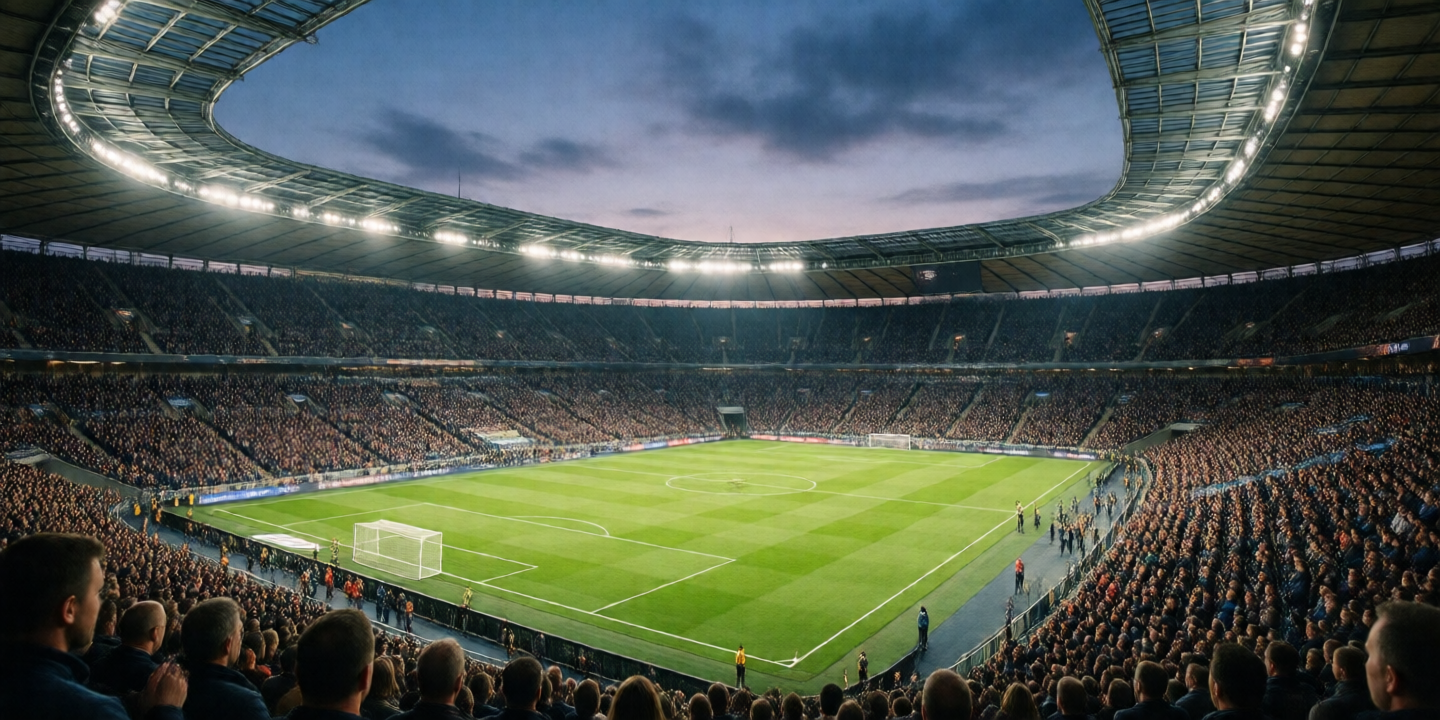
The Fan's Guide to the 2026 FIFA World Cup
The 2026 FIFA World Cup, hosted jointly by the United States, Canada and Mexico from June 11 to July 19, is the first men's tournament with 48 teams and 104 matches, up from 32 teams and 64 matches in...
The Fan's Guide to the 2026 FIFA World Cup
The 2026 FIFA World Cup, hosted jointly by the United States, Canada and Mexico from June 11 to July 19, is the first men's tournament with 48 teams and 104 matches, up from 32 teams and 64 matches in Qatar 2022. Twelve groups of four feed a new round of 32, so the top two in every group plus the eight best third-placed sides advance, which lifts a team's baseline chance of reaching the knockouts from 50 percent to 66.7 percent. Finalists now play up to eight matches instead of seven, the tournament spans 16 host cities, and the final is at MetLife Stadium in New Jersey. For anyone following the tournament or weighing odds, the practical takeaway is simple: stop treating the group stage like the old one, because goal difference across groups now decides the third-place race, and Coach's Corner tracks that table daily.
Football, the old Liverpool manager Bill Shankly liked to say, is "much, much more important" than a matter of life and death.
A useful analytical rule is simple: no opinion without a probability attached. For group matchday three, the third-place calculations indicate that the arithmetic used for twenty years no longer applies. The resulting analysis is summarized below.

What the Analysis Covers
This is not a betting system, and anyone who sells you one for a tournament that plays only 104 matches deserves your suspicion. This guide examines the claims that every casual fan repeats about the expanded World Cup, one at a time, using nothing fancier than arithmetic and the historical record summarized in Wikipedia's FIFA World Cup article. Listen up, because this is the part that matters: a claim you cannot turn into a number is just a mood. The four claims are:
- A 48-team field makes the path to the knockouts "easy" for strong teams.
- The group stage matters less than it used to.
- Favorites are safer in a bigger bracket.
- Published odds can be read straight off the screen as probabilities.
It is worth noting that every one of these claims is partly true, which is precisely why they are dangerous. The first is true for weak teams and false for strong ones. The second is true for elimination and false for seeding. The third is backwards, and the fourth is how bookmakers pay for their offices. The rest of this guide takes each claim apart in turn, so you can stop nodding along at the pub and start checking the numbers yourself. The analysis also has limits, because a model that never admits its limits is a horoscope in a nice shirt.
Setup & Key Considerations
A first consideration is geography, which no spreadsheet captures well. Sixteen host cities sit across three countries: eleven in the United States, three in Mexico (Mexico City, Guadalajara and Monterrey) and two in Canada (Toronto and Vancouver). The tournament opened on June 11 at Estadio Azteca in Mexico City, a venue that already hosted finals in 1970 and 1986, and it closed on July 19 at MetLife Stadium. Those are three time zones, wildly different altitudes and summer heat that no European-based squad plans for with a straight face.
The format can resemble a logistics tournament wearing a football tournament's jersey. That matters for prediction, not just comfort. When a team plays at altitude in Mexico City and then flies to a humid East Coast venue, the fixture list quietly becomes a variable, and a variable you ignore is an error you chose. The key is to look at who travels the least in the group stage before you form any opinion about quality. Teams that can base themselves in one region keep their recovery windows intact, and that is a real, if modest, edge that most match previews never mention.

How Does the 48-Team Format Actually Work?
Forty-eight teams are drawn into twelve groups of four, playing three matches each. The top two per group and the eight best third-placed teams, 32 in total, advance to a round of 32, followed by the round of 16, quarter-finals, semi-finals, third-place match and final.
Now the arithmetic, which is where the format earns its reputation. Twelve groups of four produce 72 group matches, and the knockout rounds add 32 more (16, 8, 4, 2, then the final and the third-place match), which gives the 104 total. FIFA's own tournament pages describe the structure, but they will not tell you what it does to the odds. A team's baseline chance of surviving the group stage rises from 16 of 32, or 50 percent, to 32 of 48, or 66.7 percent. Put differently, only 16 of 48 teams, a third of the field, are now eliminated after three matches, compared with half the field in 2022.
Here is the contrarian point that most top-ten articles skip: the group stage is now the less decisive round, and the round of 32 is the real cut. A third-placed team has an 8-in-12 chance of advancing, which is the same 66.7 percent. The ranking among thirds runs on points, then goal difference, then goals scored, so a 4-0 win against the weakest team in your group is no longer vanity. It is currency. And because the last matchday kicks off simultaneously only within each group, never across all twelve, some teams will know exactly what they need while others are still guessing. Anyone who tells you the old "just get four points" rule still works is selling nostalgia.
What the Format Supports
The historical record supports the oldest idea in the sport: the best teams still tend to be the best teams. The expanded bracket did not scramble that. The knockout path is longer, since a finalist now plays up to eight matches rather than seven, but the extra round is the one where elite sides face the weakest qualifiers. The structure supports a fatter probability mass for established powers to reach the round of 16 even as the title itself stays brutally hard to win.
The format also held up as a spectacle. Three matches per team guarantees that no nation travels across a continent for a single afternoon, and the larger field brings fan bases that never got a seat at the table before. It is worth noting that 2022 in Qatar, with its 172 goals in 64 matches, set a record for goals at a single World Cup, at about 2.69 per match. That scoring environment is what makes the goal-difference race so vivid now. The daily third-place table on Coach's Corner provides a way to track the pattern: it rewards teams that attack in the third match even when they are comfortably ahead.
- Elite teams still reach the knockouts at a very high rate.
- The extra round adds drama early without adding much randomness to the final.
- Goal difference becomes a cross-group currency, which punishes passive play.
2026 World Cup group-by-group tactical previews
Who Has Actually Won the World Cup Since 1930?
Eight nations have won the men's World Cup across 22 editions from 1930 through 2022: Brazil with five titles, Germany and Italy with four each, Argentina with three, France and Uruguay with two each, and England and Spain with one each.
That ledger is the single most useful base rate in the sport, and it comes with a caveat: the 2026 final result gets added on top of it. Look at what it says. Brazil's 5 titles out of 22 tournaments is about 22.7 percent, Germany's and Italy's four is about 18.2 percent each, and fourteen of the twenty-two trophies sit with just three nations plus Argentina. The 2022 final in Lusail is the textbook case of how thin the margin gets: Argentina and France drew 3-3 after extra time, and Argentina won the shootout 4-2, with Lionel Messi finally lifting the trophy. A shootout is, mathematically, close to a coin flip, and a coin flip decided the biggest prize in the sport.
Listen up, because this is the part that matters: history gives you a ceiling for confidence, not a floor. A nation that has won before is not "due" and a nation that has never won is not "cursed." The ledger says that eight programs have converted talent into trophies, and the number has barely moved in decades. That is a strong prior, and priors are worth respecting, but you update them with this year's squad, injuries and schedule, not with folklore about history repeating itself.

Why Do Favorites Fail More Often Than Fans Expect?
Because football scores few goals, and a title now demands five straight knockout wins. Even a team that is a 70 percent favorite in every knockout match wins five in a row only about 17 percent of the time. Short-run randomness does the rest.
The calculation is straightforward, and showing the work keeps the comparison transparent. Raise 0.70 to the fifth power and you get 0.168. If a team were a more modest 65 percent favorite in each round, the figure falls to 0.116, roughly one chance in nine. The old 32-team format needed four knockout wins after the group stage; the new one needs five, so the exact same team is strictly worse off as a title bet than it was in 2022. That is the expected-value trap of a bigger bracket: it adds a round for the favorite and no extra reward at the end.
The honest conclusion is uncomfortable. Even the single best team in the world probably carries a title probability in the low double digits, which means the "obvious" pick is wrong most of the time by construction. It is worth noting that this is not a flaw in the favorite. It is a feature of single-elimination football, where one deflection or one refereeing call can erase a month of superiority. People who feel cheated by that are not analyzing the sport; they are grieving for a version of it with more goals.
Where It Fell Apart
The format's weak points are real, and I will not flatter it. First, the 48-team field dilutes the quality of the early matches. Sixteen more teams means more matchups where one side is a heavy favorite, and heavy-favorite matches produce the least informative football. Second, the schedule is punishing: summer heat in several United States venues, long internal flights, and altitude in Mexico City make the match conditions as influential as the lineups. Third, FIFA abandoned its earlier plan for 16 groups of three in 2023 because of the risk of collusion in the final match, and the groups of four that replaced it did not remove the incentive problem entirely.
That last point is the one I care about most. With the best-third-place ranking, a team in a group whose final match has no bearing on its own qualification can still have a very real stake in goal difference. That reintroduces the "who needs what" calculation the old format mostly avoided, and it can produce dull, cautious matchdays when two teams know that a draw suits them. The key is that the incentives are not symmetrical across groups, and nobody can tell you in advance which group will deliver the awkward ending.
The odds problem also undermines the fourth claim. Outright-winner markets in a 48-team field have far more outcomes to price, and bookmakers pad the total with margin. Reading a price off the screen as if it were the true probability is how a sensible person ends up donating money to a company that employs people better at math than they are. Here is how to correct for it.
- Convert each decimal price to an implied probability by dividing 1 by the odds.
- Add up the implied probabilities for every outcome in the market.
- Divide each outcome's implied probability by that total.
- Compare the result with your own estimate, not with the bookmaker's.
how to read World Cup odds and implied probability
How Do You Turn World Cup Odds Into Real Probabilities?
Divide 1 by the decimal odds to get implied probability, then add up every outcome in the market and divide each by that total to strip out the bookmaker's margin. For example, 5.00 odds imply 20 percent, but if the market totals 118 percent, the true estimate is about 17 percent.
That 18-point overage is the margin, sometimes called the overround, and it is the quiet reason most casual bettors lose over time. In a match market with three outcomes the overround is usually modest, while outright-winner markets covering dozens of teams can carry far more. The practical tip nobody mentions: normalize before you compare any two markets, because two bookmakers can show the same headline price on a team while charging very different margins on the field around it. If you compare raw prices you are comparing apples to apples wearing different coats.
Once you have a clean probability, the decision rule is trivial, which is why so few people follow it. Only a price that implies a lower probability than your honest estimate has positive expected value, and "honest" is the operative word. Your estimate must be built from something other than loyalty, and it must be allowed to say that your favorite team is a 6 percent shot. If that makes you angry, take it up with the arithmetic. Also remember that betting is restricted to adults, varies by jurisdiction, and should be treated as paid entertainment with a loss limit you set before kickoff, not as a plan for income.

What Does the Analysis Support?
The conclusion is conditional. The 48-team format's math is more forgiving to qualifiers, but any narrative that treats the group stage as decisive should be discounted. Treat betting as entertainment spending, never as income, and set a limit before kickoff.
The verdict is straightforward: The new format is a better product for global participation and a worse one for anyone who wants clean, early sorting of the contenders. Its genuine innovation is the cross-group third-place race, which turns goal difference into a shared economy, and that table can be tracked through every future tournament that adopts it. Its genuine flaw is the extra round, which shaves a few points off every favorite's title chance.
These rules remain useful: Convert every price to a probability. Normalize for margin. Never believe a story about "momentum" that you cannot express as a number. And never, under any circumstances, call a team "due." If you want the daily version of this analysis, with the third-place table, tactical previews and player stats for the 2026 World Cup, Coach's Corner publishes it every day, and the 2026 FIFA World Cup page on Wikipedia is a sound place to confirm fixtures and results.
Coach's Corner daily World Cup coverage and player stats
Frequently Asked Questions
Q: What is the FIFA World Cup?
A: The FIFA World Cup is the international men's football championship, contested between national teams of FIFA member associations. It was first held in 1930 in Uruguay and has run in 22 editions through 2022 in Qatar, with the 2026 edition in the United States, Canada and Mexico as the 23rd. Qualification takes about three years, and the finals are held roughly every four years.
Q: How many teams are in the 2026 World Cup?
A: The 2026 World Cup has 48 teams, up from 32 in the 1998 to 2022 editions. They are split into 12 groups of four, and 32 of them advance to the round of 32. The expansion also lifts the total to 104 matches, compared with 64 in Qatar.
Q: How do the best third-placed teams qualify?
A: The eight best of the twelve third-placed teams advance, ranked across all groups. Teams are compared on points, then goal difference, then goals scored, so a heavy win can be worth as much as an extra point. That means about two out of three third-placed sides go through, so a third-place finish is no longer a failure.
Q: What is the difference between a favorite and a good bet?
A: A favorite is simply the team most likely to win, while a good bet is a price that is better than the true probability. A team can be a 20 percent favorite and still be a poor bet if the odds imply 25 percent. Convert the odds, remove the margin, then compare the result with your own estimate.
Q: Why do my odds calculations never match the bookmaker's?
A: They differ because bookmakers build a margin into every market, so the implied probabilities add up to more than 100 percent. If a market totals 118 percent, every price is inflated by roughly that amount. Divide each implied probability by the total to get a fair estimate, and compare it only with prices from the same market.
Q: How much does it cost to follow the World Cup closely?
A: Following the tournament closely can cost nothing, since match summaries, tables and tactical analysis are widely available for free, including on Coach's Corner. Spending only becomes a factor if you buy tickets, travel to one of the 16 host cities or place bets. Set a firm budget beforehand, and treat any betting spend as entertainment, not income.